
Split-Face Limestone Cladding: An Architectural Texture Guide for Exterior & Interior Walls
How the split-face texture of Portuguese limestone from Central Portugal behaves on exterior façades and interior feature walls, and which formats suit which architectural intent.
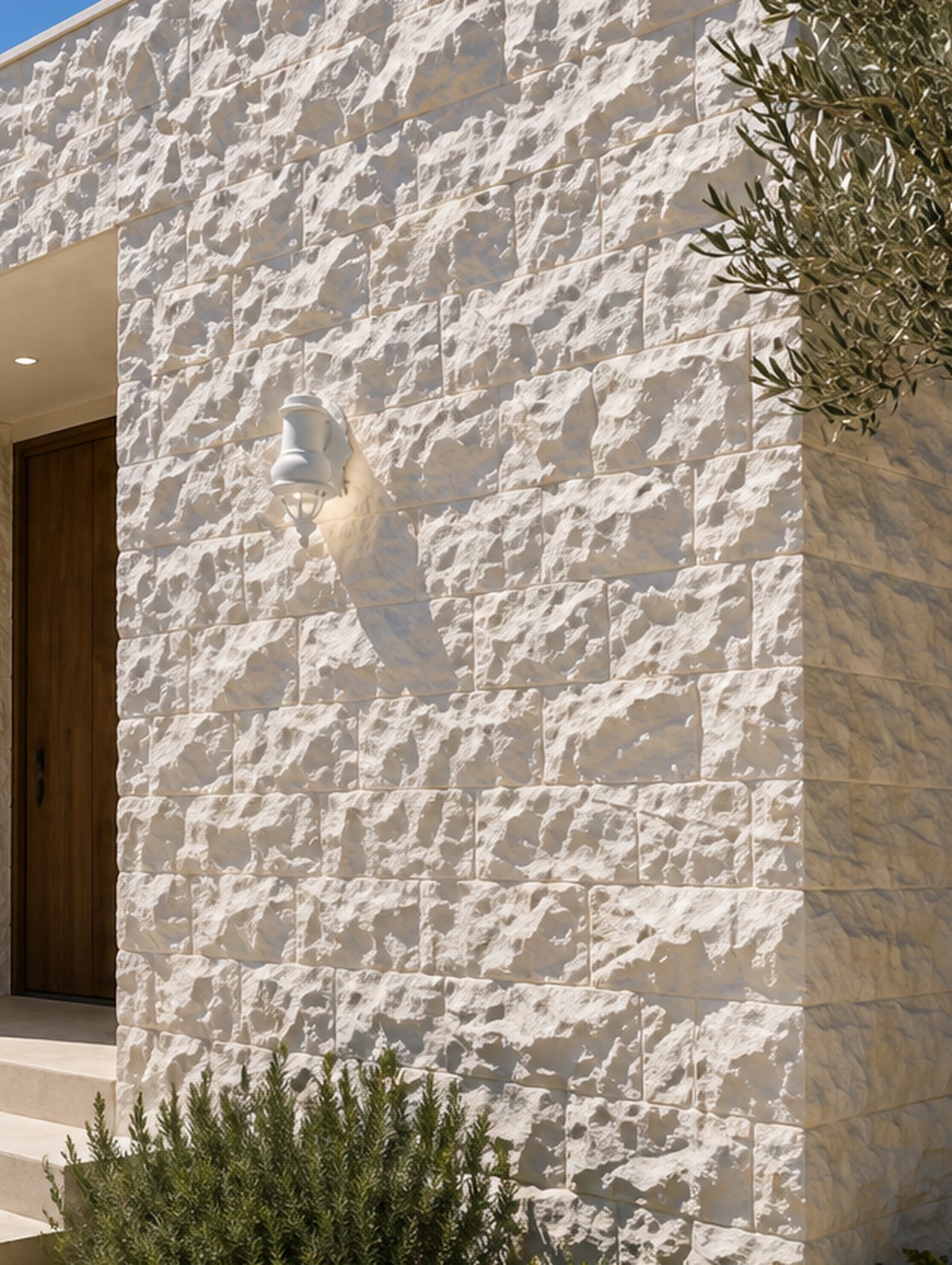
Splitting stone rather than sawing it is one of the oldest gestures in European building. Long before mechanical saws, a mason opened a limestone block along its natural beds with wedges and let the fracture itself become the visible face. That face — irregular, faceted, alive with small projections and recesses — is what we now call split-face, and it is the reason limestone walls in old Mediterranean towns still look like stone rather than like cladding.
Valtherra Stone supplies Portuguese limestone quarried in Central Portugal, prepared for exterior and interior wall cladding. This guide explains what the split-face texture does on a building, how the formats differ, and how the surface behaves in light, at corners and over time.
The Heritage Behind a Split Face
Portuguese limestone has been quarried, split and built with for centuries. It is one of the classic building stones of Western Europe: won in useful blocks, opened along its beds, dressed by hand and, where a design asked for it, carved. In Portugal it was never a specialist import but the local material, used across the central and western regions for monasteries and parish churches, civic buildings and market halls, farmhouses, courtyards, boundary walls and paving — structurally in the wall and ornamentally above the door, often from the same quarry.
Central Portugal lies within the country's principal limestone belt, and the limestone heritage of Central Portugal is exactly this accumulated practice: beds that are known and followed, blocks read for tone and grain before they are opened, and the craft judgement that decides whether a face is split or dressed. The stone supplied today is contemporary quarry material prepared for modern assemblies rather than the material of any named monument, but it comes from the same limestone belt and the same working tradition — which is why it is familiar to European architectural practice and specified internationally.
The split face is where that lineage is most directly visible. It is not a manufactured effect applied to the stone; it is the stone's own fracture surface.
Surface and Format: Two Separate Decisions
Two specification axes describe every product, and keeping them apart is the single most useful habit when writing a limestone specification.
Surface describes the visible face. Most of the range carries the natural split-face texture: the stone is split rather than sawn or polished, so the face on the wall is the face the block reveals. One product carries a hand-chiseled surface instead, where the face and arris are worked by hand.
Format describes the geometry of the supplied piece: Irregular, Rectangular or Multiformat.
The two axes combine. A product supplied rectangular with a hand-worked face is specified as Rectangular Format with Hand-Chiseled Surface — rectangular is the format, hand-chiseled is the surface. Writing "hand-chiseled format" or "rectangular surface" invites confusion, so set the two out as separate lines.
What Split-Face Texture Means
Split-face limestone cladding is produced by splitting natural quarry blocks to expose the inner bedding and structural relief of the stone.
Unlike sawn or honed slabs, split-face cladding is deliberately non-flat. Individual pieces carry natural projections, recesses, uneven arrises and subtle tonal shifts. The result is a wall with real visual depth, tactile warmth and genuine character rather than a printed or simulated stone effect.
Natural variation is inherent to the material. As a natural stone, limestone may present variation in colour, tone, texture, surface, shape and thickness. Reviewing a representative sample set or a mock-up panel before main production, and agreeing the accepted range, is the simplest way to make that variation an asset rather than a surprise.
Relief, Light and Shadow
The value of a split face is almost entirely about light.
Because the surface is faceted rather than flat, every piece carries its own small topography of highlights and shadows. In direct sun or under angled exterior lighting the relief reads as sharp and sculptural, with crisp shadow lines along each break. Under soft overcast light the same wall reads as calm, deep and softly modelled. Under warm interior spotlights it becomes richly tactile, with the grazing light picking out the depth of each fracture.
This means a split-face wall is never quite the same wall twice. It changes through the day and through the seasons, and in northern climates where the sky is flat and grey for long stretches, that ability to hold interest without strong colour or pattern is one of the material's real advantages. Limestone's matt, mineral surface diffuses light rather than reflecting it, so the effect is depth rather than glare.
Split-face limestone is therefore a strong choice where a project wants an authentic natural stone façade, genuine three-dimensional relief, a Mediterranean or contemporary-organic design language, deliberate contrast alongside glass, metal, timber or render, or a feature wall whose character shifts with the ambient light.
Tactile Character and Tonal Variation
A split face invites touch as well as sight. The arris is not machined, the plane is not perfect, and running a hand across it registers the stone as a mineral solid rather than a surface finish. On entrance walls, reception areas and interior features — anywhere the wall is seen and touched at close range — this tactile quality is a large part of why the material is chosen.
Tonal variation works with the relief. Valtherra Stone organises the Central Portugal range into three collections — Luminous Ivory, Sunset Gold and Alpine Heritage — spanning soft ivory and cream, beige and honey tones, and greys. Within a collection, pieces differ from one another, and on a split-face wall those differences are amplified by shadow: a slightly darker piece in a recess reads deeper still, a paler face catches more light. Distribute tonal variation intentionally across an elevation rather than leaving it to the order in which pallets are opened.
The Formats and What They Are For
The split-face texture stays constant across most of the range. What changes is the format — the geometry and coursing of the pieces.
| Format and surface | Character on the wall | Typical architectural intent |
|---|---|---|
| Irregular format, natural split-face surface | Freeform pieces, varied sizes, organic coursing | Quarried, traditional façades, garden and boundary walls |
| Rectangular format, natural split-face surface | Regular coursed pieces with straight edges | Ordered contemporary walls and clean horizontal banding |
| Multiformat, natural split-face surface | Coordinated mixed sizes laid in a designed pattern | Layered wall compositions with movement and scale variation |
| Rectangular Format with Hand-Chiseled Surface | Rectangular pieces with a hand-worked face and arris | Crafted, tactile walls where the hand of the mason should be visible |
Irregular format
Irregular limestone gives the least repetition and the most natural rhythm. It suits walls that should look quarried rather than manufactured, and it asks for more setting-out judgement on site.
Rectangular format
Rectangular limestone keeps the split-face surface but disciplines the coursing. It is the natural choice when the architecture wants textured material inside a controlled geometric grid, and it is the most straightforward format to set out around openings.
Multiformat
Multiformat combines several coordinated piece sizes in a designed layout, giving a large elevation scale and variety without losing coherence. Agree the laying pattern before work starts, otherwise the mix drifts across the wall.
Rectangular Format with Hand-Chiseled Surface
Supplied rectangular, with the visible face worked by hand so that face and arris carry a tooled, defined character. It carries the strongest sense of craft and reads particularly well on entrance walls, feature walls and elevations seen at close range.
Typical Applications
This limestone is prepared for vertical wall use: exterior building cladding and rainscreen façades; interior feature and accent walls; entrance lobbies and reception walls; fireplace surrounds and chimney breasts; boundary walls, garden walls and landscaping elements; and decorative pillars, columns and corner elements.
Because of its pronounced surface profile, split-face limestone is intended for wall installation rather than pedestrian traffic surfaces.
Corners
Corners are where a change of plane meets an exposed edge, so they deserve early attention. Pre-formed L-shaped corner elements are available in selected stone collections and formats. The wrapped return conceals the cladding thickness, so the corner reads as solid stone masonry rather than as an applied skin with a visible edge. Corner elements are available in the same formats as the cladding.
Resolve corners alongside the fixing system and before setting-out drawings are issued.
Exterior Walls and How the Texture Ages
On an exterior elevation, the wall around the stone matters as much as the face of the stone. Keep water moving away from the cladding: shed water at every horizontal surface with a fall and a drip, keep the base clear of paving, planting and standing water, keep cavity drainage and ventilation paths unobstructed, aim for full and even bedding coverage where the cladding is adhered, and fill joints so they shed rather than hold water.
Given that, a split-face wall ages particularly well. Relief means shadow, and shadow absorbs the small irregularities that time introduces — a slight darkening in a recess, a lighter dressed edge, an area that has taken more rain than its neighbour. Exposed elevations gain tonal depth, sheltered ones stay closer to their original colour. Instead of looking worn, the wall gains patina: a settled, slightly deeper tonality that most architects consider an improvement on the day of handover. This is why textured limestone suits buildings intended to look better in ten years than in their first photograph.
Cleaning and Maintenance
Maintenance is light but worth scheduling.
- Clean with neutral-pH solutions intended for natural calcareous stone
- Remove atmospheric dirt with a soft bristle brush and a low-pressure water rinse
- Avoid acidic cleaners, vinegar, brick wash and harsh descaling chemicals
- Avoid metal wire brushes, which can scratch the face or leave iron particles
- Trial any specialised cleaner on an inconspicuous area first
Pressure washing deserves caution: high pressure applied too closely can erode joints or damage the surface texture. Deep relief can collect dust or organic debris on sheltered ledges, so occasional soft-brush cleaning is sensible on exposed elevations.
An impregnating, vapour-permeable water-repellent intended for exterior wall cladding can help reduce moisture penetration and staining while keeping the wall breathable. Evaluate any treatment for the specific stone, surface character and exposure, and trial it on a sample first. A treatment does not replace correct drainage.
Frequently Asked Questions
What is the difference between format and surface?
Format is the geometry of the supplied piece: Irregular, Rectangular or Multiformat. Surface is the visible face: the natural split-face texture, or a hand-chiseled surface. One product combines both axes as Rectangular Format with Hand-Chiseled Surface. Specify format and surface as two separate lines.
Is split-face limestone suitable for interior feature walls?
Yes. It is widely used for interior feature walls, entrance foyers, reception areas and fireplace surrounds, where its relief and tactile character give warmth and depth.
Which format is easiest to use on a large elevation?
Rectangular and Multiformat are usually the most straightforward, because their coursing is designed and repeatable. Irregular is generally chosen where a freeform, quarried look is the objective.
Can several formats be combined on one project?
Yes. An irregular or hand-chiseled feature wall alongside rectangular surrounding elevations creates architectural contrast while keeping tonal harmony, because all formats come from the same quarry source.
How are corners handled?
Pre-formed L-shaped corner elements are available in selected stone collections and formats. The wrapped return conceals the cladding thickness so the corner reads as solid stone masonry, and corner elements are available in the same formats as the cladding.
Does the stone need sealing?
Sealing is optional and depends on exposure. Any product used must be vapour-permeable, suitable for natural limestone, and trialled on a sample before general application.
Conclusion
A split face gives a wall what no flat surface can: real relief, real shadow and a surface that changes with the light. It is the oldest way of showing limestone, and it remains the most convincing. The design decision is a pairing — which surface character carries the intent, and which format carries the composition. Irregular for freeform character, Rectangular for disciplined coursing, Multiformat for layered scale, and Rectangular Format with Hand-Chiseled Surface for visible craft.
Valtherra Stone supplies Portuguese limestone from Central Portugal for exterior cladding and interior wall projects. Contact our team to request physical samples or discuss formats.
Natural stone should be selected, specified and installed in accordance with the applicable product documentation, local requirements and intended use.
Interested in this stone for your project?
Discuss available formats, quantities and delivery requirements with our team.
Request a Quote