
Portuguese Limestone vs Travertine: Exterior Facade Comparison
A comprehensive comparison of Portuguese limestone and travertine for exterior architectural facades.
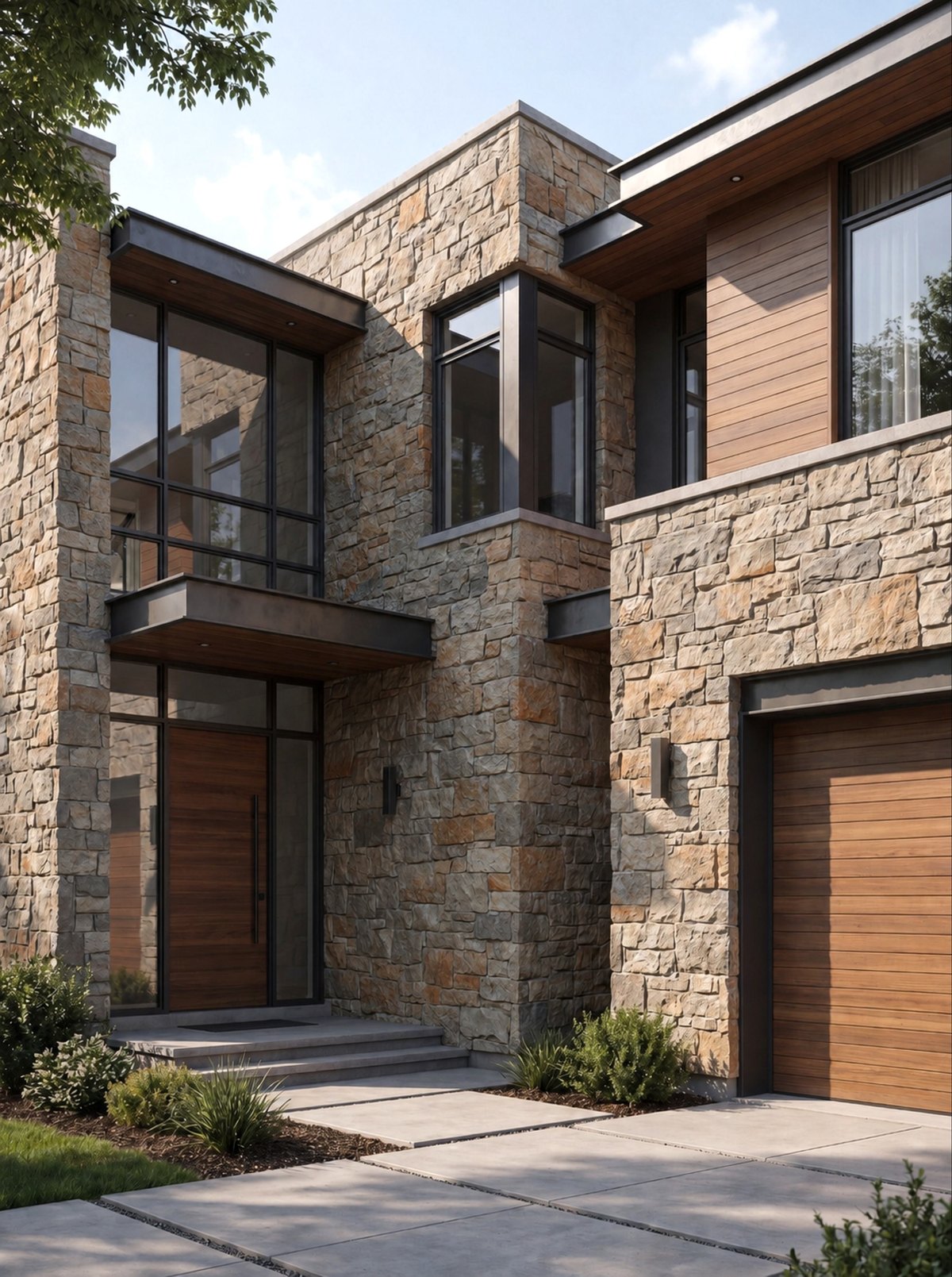
Limestone and travertine are the two natural stones most often placed side by side when an architect is choosing a warm, light-toned material for an exterior façade. Both are carbonate stones, both have a long presence in European building, and both offer the calm, mineral quality that makes natural stone worth specifying in the first place. They are, however, genuinely different materials, and the difference is easiest to understand by starting with where each one comes from.
Valtherra Stone supplies Portuguese natural limestone from Central Portugal, prepared as wall cladding for exterior and interior architecture. This comparison sets out how the two stones differ in formation, appearance, surface character, ageing and use, so that the choice can be made on architectural grounds rather than on assumption.
The Architectural Standing of Portuguese Limestone
Portuguese limestone has been quarried and built with for centuries. It is one of the classic building stones of Western Europe: quarried in useful blocks, split along its natural beds, dressed by hand and, where a design asks for it, carved. That combination of solidity and workability is why limestone was used for load-bearing walls, arcades, window surrounds, thresholds, staircases and church interiors, and equally for plain rural houses and boundary walls.
In Portugal the material is not a specialist import but the local stone. Across the central and western regions it built monasteries and parish churches, civic buildings and market halls, farmhouses, courtyards and paving — structurally and ornamentally at the same time, often from the same quarry. Central Portugal sits within the country's principal limestone belt, and the limestone heritage of Central Portugal is precisely this: a deep extraction culture, generational quarry knowledge, and craft skills for splitting, dressing and matching the stone that still survive around the working faces.
The material Valtherra Stone supplies today is contemporary quarry stone prepared for modern cladding assemblies. What it shares with the region's historic architecture is provenance, geology and craft lineage — the same limestone belt and the same working tradition — rather than any claim to a named monument. That lineage is the reason the stone is familiar to European architectural practice and specified internationally: its colour, texture and ageing behaviour are known quantities.
Geological Formation
The clearest distinction between the two materials is how they were formed.
Limestone is a sedimentary carbonate rock, formed over long geological periods by the accumulation and compaction of carbonate sediments and marine organic material on ancient sea beds. The result is a comparatively homogeneous, close-textured stone with visible bedding and a fine, even grain. Because it was built up in layers under pressure, it splits cleanly along those beds — which is why limestone has always been a stone that masons could open with a wedge rather than only with a saw.
Travertine is also a carbonate stone, but it forms differently: it is precipitated from mineral-rich waters, typically around springs, where calcium carbonate is deposited progressively as water degasses and evaporates. That process traps gas bubbles and organic matter, and it leaves the stone with its most recognisable trait — the open pores, channels and voids that run through it, generally following the direction of deposition.
Neither origin makes a stone better than the other. But it does mean the two materials present very different surfaces, and that they are cut, finished and used in different ways.
Visual Character
Portuguese limestone reads as a quiet, even material. Its bedding produces gentle tonal movement rather than strong figure, so a large elevation clad in it looks continuous and composed. Because the grain is fine and consistent, the eye registers the wall as a mass of stone rather than as a collection of individual patterned pieces. This is a considerable advantage where the architecture wants a calm backdrop — a long façade, a plinth to a glazed volume, a wall that has to hold its own next to concrete or dark metal without competing.
Travertine reads as a more expressive material. The linear pores and channels give it a distinct, directional character that is often described as banded or veined depending on how the block is cut. Cut one way it shows long parallel movement; cut another it shows a cloudier, more mottled figure. This is genuinely attractive and has been used to great effect in both classical and modern architecture, but it is a stronger visual statement, and it asks to be laid with a considered pattern rather than randomly.
In practical terms: limestone tends to recede and unify, travertine tends to assert and articulate. Which is preferable depends entirely on what the elevation is being asked to do.
Pore and Surface Character
This is where the two materials diverge most on a building.
Limestone's surface is comparatively closed and even. It takes a range of finishes and, importantly, it splits well — which allows a natural split-face texture where the stone's own fracture surface becomes the visible face, with real relief and depth rather than a machined flatness.
Travertine's surface carries its characteristic voids. In much commercial use these are filled and the surface honed or polished, giving a smooth, uniform plane; left unfilled, the stone keeps its open, sponge-like texture, which is a deliberate and often beautiful choice. Both approaches are legitimate, but each brings consequences for an exterior wall: filled surfaces depend on the fill remaining sound and visually consistent over time, while unfilled surfaces present open cavities on the face, and on an exposed elevation those cavities interact with rain, dirt and organic growth in a way that a closer surface does not.
For an exterior façade in a wet or dirt-laden environment, the more closed and self-similar the surface, the more predictable its long-term appearance tends to be. This is the practical reason limestone is often the easier of the two to specify for a large exposed elevation — not because travertine is unsuitable, but because it requires the surface decision to be made more deliberately.
Colour and Tonal Variation
Both stones sit in the warm, light part of the natural-stone palette, which is why they are so often shortlisted together.
Portuguese limestone runs from soft ivory and cream through beige and honey tones into greys. Valtherra Stone organises this range into three collections — Luminous Ivory, Sunset Gold and Alpine Heritage — so that an elevation can be given a deliberate tonal character. Within any collection, individual pieces differ in colour, tone, texture, shape and surface: variation is the signature of a natural sedimentary stone, and it is what makes a wall read as stone rather than as a manufactured panel. On a project, the sensible approach is to agree the acceptable range through samples or a sample panel and to distribute tonal variation intentionally across the elevation.
Travertine covers a comparable warm range — ivory, beige, walnut and silver-grey tones — but its variation is expressed through its banding and pore structure as much as through colour, so tonal blending is bound up with pattern matching. Where limestone can usually be blended piece by piece, travertine often needs to be laid to an agreed direction and sequence.
Ageing and Patina
Both materials age; the question is how.
Portuguese limestone weathers gradually and at the surface. On a well-detailed wall, exposed elevations gain tonal depth, sheltered ones stay closer to their original colour, and areas taking concentrated run-off darken first. Textured surfaces age particularly well, because relief means shadow, and shadow absorbs the small irregularities that time introduces — a slight darkening in a recess, a lighter dressed edge. Rather than looking worn, the wall gains patina: a settled, slightly deeper tonality that most architects regard as an improvement on the day of handover. This is one of the strongest arguments for limestone on buildings intended to look better in ten years than in their first photograph.
Travertine also develops patina, and unfilled travertine in particular can weather with great character. Its open structure means, however, that dirt and organic growth find purchase in the voids, and that any filled areas may weather at a slightly different rate from the surrounding stone. That is not a flaw; it is simply a behaviour to anticipate and to accept as part of the material's expression, or to manage through detailing and cleaning.
For both stones, the wall around the stone matters at least as much as the stone itself. Overhangs, drips, sills, copings and generous plinths — the details that traditional carbonate-stone architecture is full of — are what keep water moving away from the face and allow the surface to dry between wettings.
Maintenance
Maintenance for both materials is light but should be scheduled rather than left to chance.
For Portuguese limestone: clean gently and occasionally to remove dirt and organic growth, trialling the method on a discreet area first; inspect joints, sealed penetrations, copings, flashings and drainage paths seasonally; clear blockages before winter; repair small defects early. A closer, more even surface makes cleaning comparatively straightforward, and textured split-face surfaces are forgiving of minor blemishes.
For travertine: the same principles apply, with the addition that open pores need a cleaning method chosen with the texture in mind, and that filled surfaces require the condition of the fill to be part of the inspection. Both stones respond badly to aggressive treatment, and any surface treatment being considered should be evaluated for the specific stone and surface character and trialled on a sample before general use.
Applications
Both stones are used across the same building types, and the choice is usually about intent.
Portuguese limestone suits long exterior elevations, plinths and bases, entrance walls, courtyard and garden walls, and interior feature walls, stair cores and fireplace surrounds. Because the same stone can move from outside to inside, a single material idea can run through a building. It sits comfortably with glass, exposed concrete, timber, dark metal, render and zinc, providing mass and warmth without demanding attention — which is why it appears equally in Mediterranean vernacular, restrained contemporary housing, hotels and civic projects. Its matt, mineral surface diffuses light rather than reflecting it, so a limestone wall changes through the day and holds interest even under flat, overcast northern light.
Travertine is at its strongest where its pattern is an asset: feature elevations, entrance halls, framed panels, and interiors where a directional figure can be laid out and enjoyed. It is also widely used in flooring and paving contexts where limestone appears too.
Split-Face and Textured Surfaces
Textured surfaces deserve their own note, because this is where limestone has a particular advantage.
Because limestone splits cleanly along its beds, a natural split-face texture is a true fracture surface rather than a simulated one. The relief is genuine, so it catches raking light, throws real shadow and gives an elevation depth and tactile character. Valtherra Stone supplies natural split-face texture as its standard surface character, and one product as a rectangular format with a hand-chiseled surface, where the visible face and arris are worked by hand for a more defined, tooled character.
Format and surface are two separate specification items, and keeping them separate avoids confusion at tender. Irregular, Rectangular and Multiformat describe geometry. Natural split-face and hand-chiseled describe the face. Irregular gives a quarried, traditional wall; Rectangular gives coursed discipline and is the most straightforward to set out around openings; Multiformat mixes coordinated sizes for scale variation while keeping coursing legible. Pre-formed L-shaped corner elements are available in selected collections and formats, and their wrapped return conceals the cladding thickness so a corner reads as solid stone masonry rather than as a clad face with a visible edge.
Travertine can of course be supplied with textured and split surfaces as well; the difference is that its texture is inseparable from its pore structure, which gives a different — more open, more porous — kind of relief.
Advantages and Limitations
Portuguese limestone — advantages. A calm, unifying appearance across large elevations; a warm, light tonal palette that suits northern light; a comparatively closed and even surface that behaves predictably on exposed walls; excellent workability, which supports coursed cladding, hand-worked faces, corners and special pieces; genuine split-face texture; graceful, surface-level patina; easy pairing with contemporary materials; and continuity between exterior and interior use.
Portuguese limestone — limitations. It is a quiet material, and where a design wants a strong, expressive figure it will deliberately not provide one. It is porous to some degree, like all natural stone, so it depends on a well-drained wall and sound detailing. Natural variation in colour, tone, texture, shape and thickness has to be accepted and managed through samples rather than expected to be uniform.
Travertine — advantages. A distinctive, expressive character with strong architectural presence; a comparable warm palette; long and distinguished use in both classical and modern architecture; flexibility between filled-and-honed and open-textured surfaces; and a directional figure that can be composed deliberately.
Travertine — limitations. Its open pore structure makes the surface decision — filled or unfilled — consequential for exterior use and long-term appearance; pattern matching and laying direction need to be agreed rather than left to the installer; and cleaning has to be chosen with the texture in mind.
Making the Choice
A short set of questions usually resolves it. Should the wall recede and unify, or assert and articulate? Is the elevation large and exposed, or a framed, sheltered feature? Is a directional pattern desirable, or a distraction? Is genuine split-face relief part of the architectural idea? And is the same material intended to continue inside?
Where the answer favours a calm, textured, warm-toned wall that will weather into patina and carry from exterior to interior, Portuguese limestone from Central Portugal is a natural fit — and it brings with it centuries of architectural precedent in exactly that role.
Discuss Your Project
If you are comparing natural stones for a façade, we can work through collections, formats, surface character, corner treatment and delivery.
Request a Quote with your elevation areas, formats, thicknesses and delivery destination, or contact us to discuss samples and formats for your project.
Natural stone should be selected, specified and installed in accordance with the applicable product documentation, local requirements and intended use.
Interested in this stone for your project?
Discuss available formats, quantities and delivery requirements with our team.
Request a Quote